
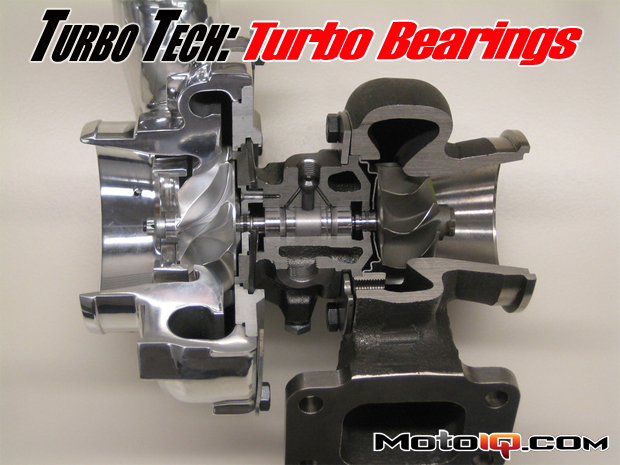
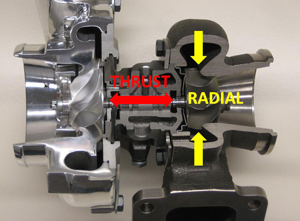
We like turbos at MotoIQ. Why? In the phrase made famous by Tim Allen, "more power!" In order for a turbo to cram air into an engine, it has a pair of wheels and a shaft spinning at incredible speeds. Depending on the size of the turbo, they can spin anywhere from 100,000 rpm (big turbos) to 300,000 rpm (small turbos). 300,000 rpm equals 5000 revs a second. Put another way, if you rolled a compressor wheel on the ground, it would go about six football fields a second. That's about 1.7 times the speed of sound. Wrap your head around that! The rotating assembly consisting of the shaft, turbine wheel, and compressor wheel encounter axial and radial loads that want to push the wheels into the housings and rub parts together. To keep the rotating assembly supported and freely spinning, turbos currently either use a journal or ball bearing system. There are variations on each theme, but we're going to go over the most common designs. First, we need to discuss the loads they encounter.
 |
 |
Check out the rest of the article at Moto IQ